|

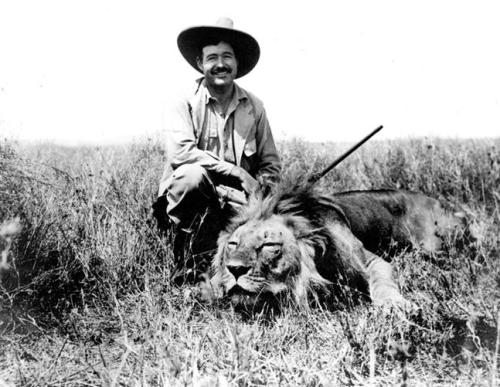
Hemingway (far right) and Charles Thompson (2nd from left) during their
1933 African safari.
|
Hemingway Resource
Center>Exclusives>Feature Articles>Hemingway's
Best Friend by Tom Sanders
In the mid-70's, I worked as a television journalist in Miami, and that
is how I came to meet and interview
Charles and Lorine Thompson. This is also the
story of my failed effort to interview Hemingway's brother.
For a time at Post-Newsweek's WPLG-TV, I had the best job in the news
department. I was the feature reporter. I traveled around Florida
and reported on anyone and anyplace I thought
would be of interest to viewers of the news
program. The station's channel on the dial was 10. I called
the feature 'Ten Country'.
One night in the newsroom, I happened to glance at a bank of TV
monitors. A heavyset man wearing a safari
jacket and sporting a handlebar mustache was
extolling the pleasures of gambling at Miami's Jai Alai Fronton. I
reached and turned up the audio.
" That guy's a real character." I thought aloud. "Who is he?''
Larry King was writing the evening sports report at an adjacent desk.
"That, my friend, is Leicester Hemingway,
Ernest's brother."
"I've been thinking about a series on Hemingway's years in Florida. I
wonder if he'd do an interview?"
"Why don't you ask him?'' King removed a card from his Rolodex and
tossed it to me. ''Here's his phone number."
Leicester was quite the eccentric. He agreed to the interview in Miami,
then changed his mind, and insisted on Bimini. Moreover, he
wanted to be paid. I explained that my
employer had a policy against paying for news
interviews. The more we talked, the more I wanted to do the interview.
Leicester had great stories to tell about his brother. After numerous
phone calls, we reached what I thought was agreement. There would
be no payment for the interview. However, I
would pay for Leicester's ticket to Bimini on
Chalk Airlines out of my own pocket.
In the meantime, My cameraman Gino Bruno and I were off to Key West to
video tape other segments for the Hemingway series. We had
pitched the idea to the executive producer who
gave it his blessing.
The first day's shooting went well. The people at the Hemingway House on
Whitehead Street gave permission to roam the house and grounds as
we pleased. By late afternoon, we had most of
what we needed to produce a good feature.
Gino's shot list included the penny Hemingway had stuck in
wet cement by the pool, the six-toed cats and the urinal
Hemingway had taken from a bar and turned into
their watering trough, the pool house where
the author did his writing.
The only story element missing was an interview with someone who had
known the writer when he lived in Key West. It
had, after all, been almost 40 years.
When doing a story on Hemingway and you're not sure how to proceed, have
a drink. Gino and I found our answer over Cuba
libras at Sloppy Joe's. The bartender joined
our conversation, made a few phone calls and by the time
we stumbled back to our motel, we had an interview the next
morning with Charles and Lorine Thompson.
I stayed up most of the night re-reading Carlos Baker's biography.
Over breakfast, Gino, admitting literary ignorance, asked why Charlie
and Lorine Thompson were such an important
interview?'
I reached for my carry bag, took out a file, and handed him the lead-in
to the story I had drafted overnight.
'The ten or so years Hemingway lived in Key West were among his most
productive years as a writer. He wrote in the mornings, fished in
the afternoons, and often spent his evenings
drinking with friends. One of those friends,
many say his best friend, was Charles Thompson, the owner of
a marine hardware store and a couple of other businesses.
Hemingway's wife Pauline and Charlie's wife Lorine became very close
friends. Charles went on an African safari with Ernest, and was one of
the few men that ever out-shot him. The
character 'Old Karl' in ''The Green Hills of
Africa'' is based on Charles Thompson. And, there is a lot of Charles
Thompson in the character Harry Morgan in the novel 'To Have and
Have Not'.
The friendship lasted long after Hemingway and Pauline divorced and he
left Key West, right up to the time Hemingway
committed suicide.'
We arrived early at the Thompson home. Bill Geyser, who helped care for
the Thompson's, greeted us at the door and suggested we come in
and set up the equipment. Charles and Lorine
would be down in a while, he explained.
I helped bring the camera and light cases into the house. Two elderly
black Labrador retrievers wandered in, sniffed
me and Gino, decided we were okay, and then
settled in on a well-worn couch. I left Gino to do the set-up, and
had a look around. The room had a musty smell. It was not
unpleasant and reminded me of a museum.
Shelves were filled with books from floor to
ceiling. There were signed first editions by John Dos Passos, and F.
Scott Fitzgerald. I carefully opened a copy of
'The Old Man And The Sea'. On the cover page
was a personal note from Earnest to Charles and Lorine.
A painting by Waldo Peirce hung from the wall. Various skins, warrior
shields, and other African artifacts were displayed around the room. I
was admiring the long corkscrew horns of a
bull kudu when I heard footsteps.
"Yes, those are the horns." Lorine announced as she carefully made her
way down the stairway. I assumed that Lorine
was referring to the fact that some of Charles
trophies from the African safari with Ernest had been more
impressive than those of his host. They were very competitive,
Hemingway and Thompson, and Charles' superior
kudu horns had almost caused a rift between
the two men.
I introduced Gino, and myself and presented Lorine with a bouquet of
flowers. That earned a smile and brought a twinkle to her eyes. Charles
followed Lorine down the stairs. The Labradors made room as they
settled onto the couch.
I was struck by their frailty. Old age was taking its toll. Yet I sensed
a grace and dignity about them that time had
not diminished. They had lived a fascinating,
full life, were quick to laugh and possessed of a gentle,
self-deprecating sense of humor.
I nodded to Gino to start the camera rolling, and began the interview
with Charles.
"Mr. Thompson, tell us about how you and Hemingway met."
"Well, he was fishing off a bridge and got to talking to a friend of
mine, Charlie Brooks. I think he'd run out of
bait, and Charlie gave him some. Anyway,
Charlie told him if he liked to fish, he ought to come see me. So
he came into the hardware store and introduced himself
said he was Ernest Hemingway, a writer,
and he wanted to do some fishing. I took him out
after work."
"Did you and Hemingway become friends right away, or did it take awhile
for the friendship to develop?'' As I asked
the question, I noticed Charles looked
confused.
"Well, he was fishing off a bridge and got to talking to a friend of
mine, Charlie Brooks. I think he'd run out of
bait, and Charlie gave him some. " Charles'
voice trailed off. He turned to Lorine, an anxious look on his
face. She took his hand in hers.
"Charles sometimes forgets,'' she said softly. "He's getting old. We're
both getting old." She laughed. ''Now, what else did you want to know?''
For the next half-hour, Lorine talked about Ernest and Pauline, how they
all became close friends, and how sad they were when Ernest and
Pauline divorced, and Ernest left Key West.
Bill Geyser kept glancing around the doorway, and I realized he was
about to end the interview.
"One last question, Mrs. Thompson. When did you and Charles last see
Hemingway, and did you have any premonition that he might commit
suicide?''
Lorine paused for a minute before answering. ''I think it was maybe a
year, maybe two, before he died. He still owned the property on
Whitehead Street, you know, and he and his
fourth wife Mary had bought a house in
Ketchum. They had to leave Cuba. Mary was in New York at the time I
think and Ernest had come down alone. He
stayed with us here.
One thing about Ernest, he had a real presence. When he walked into a
room, people would stop talking and look up. He always walked on
the balls of his feet, and you could hear him
coming. He made a lot of noise.
Well, one morning I was reading down here and I suddenly realized Ernest
was standing behind me. I hadn't heard him come down the stairs
and it startled me. It was like he was a ghost
of himself. I thought about that when he
died."
~
When we arrived back in
Miami, there was a message to call Leicester. We
were scheduled to fly to Bimini the next morning and do the
interview.
Leicester answered on the first ring.
"Are you all set Leicester? I've got the tickets and we'll meet you
around nine at Watson Island."
There was a long pause. ''Still there, Leicester?"
Leicester spoke. "There's just one thing."
Oh boy! I thought. Here it comes. "And what is that?"
"You can't ask me anything about Ernest?"
"You won't discuss your brother?"
"Any questions about Ernest and I walk away from the interview."
I knew it was pointless to ask why. I had spent a memorable afternoon
with Ernest Hemingway's best friend. I didn't
want to argue with his brother.
"Leicester, without those questions there is no interview. Good bye and
take care." I gently placed the receiver back in its holder. I
have
regretted it ever since.
The Thompson's died some
years ago. Leicester Hemingway committed suicide
in 1982. The videotape transcript of the interview was destroyed
in a hurricane.
©2001 Tom Sanders
Tom Sanders lives and writes in Germany.
His short story 'The Meglodon
Curse' is an HRC short story winner and is archived on this
website.
|